
The paper led by Arianna Tartara explored the process by which fallen leaves are broken down to recycle nutrients back into the forest, recovers after disturbance in Ecuador’s lowland Chocó. Studying sites ranging from active cacao plantations to regenerating secondary forests and old-growth forest, they found that decomposition follows a U-shaped recovery pattern, dipping during mid-succession before bouncing back in mature forest. This suggests that the insects and other invertebrates doing much of this work are surprisingly sensitive to where a forest is in its recovery journey. The study is a valuable reminder that restoring a forest isn’t just about the trees, the invisible processes happening on the forest floor matter just as much.
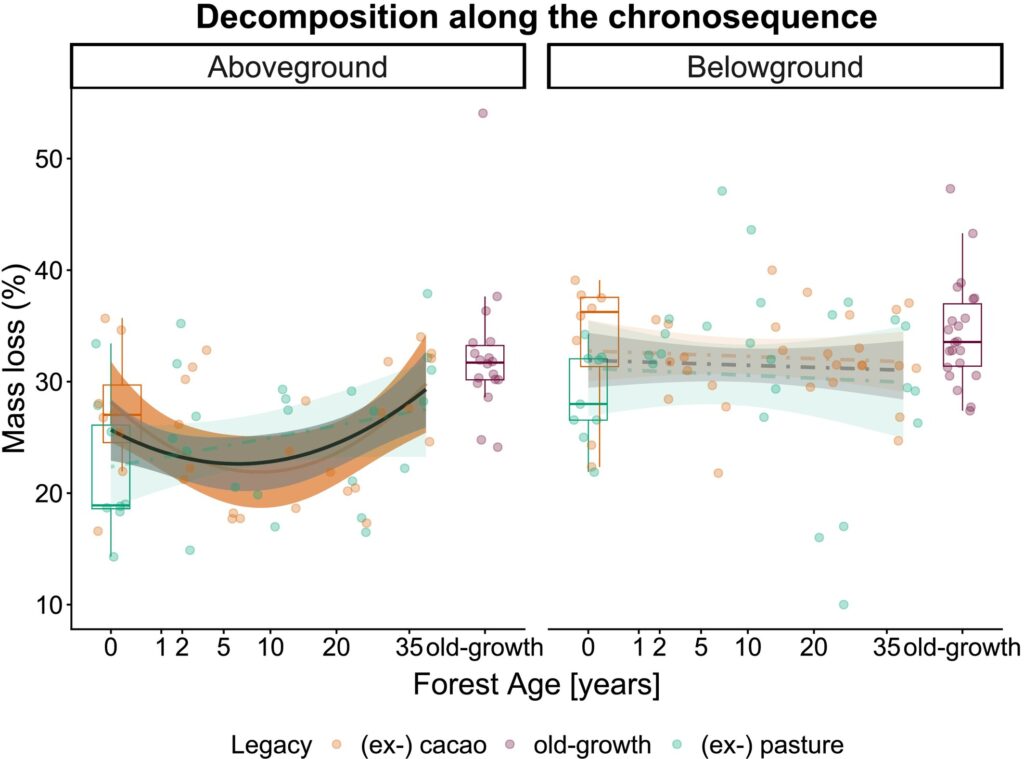
Leaf litter decomposition dynamics measured above- and belowground at three time points along a chronosequence of tropical forest regeneration from two different land-uses, where dots represent mean mass loss per subplot and timepoint; lines with shading represent modeled relationships with confidence intervals; solid lines with opaque CIs stand for statistical significance as opposed to dashed lines with transparent CIs; green is pasture, orange is cacao plantation, purple is old-growth forest; black/gray is the overall chronosequence model in which old-growth forests were not included; the data distribution of old-growth plots is instead represented by boxplots, showing medians, interquartile range and whiskers.