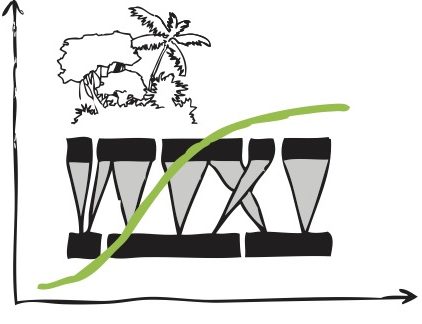

Diniz et al. studied pollinator communities in the understory and canopy and recorded 2,000 plant-pollinator interactions using pollen DNA metabarcoding. They found that moths, stingless bees, and nocturnal bees were all far more abundant and diverse in the canopy, a pattern already evident in younger, late-successional forest canopies, not just old-growth. The exception was orchid bees, which actually preferred the understory. Likewise, plant-pollinator networks were richest and most distinct in canopies, and the most diverse, best-connected networks were found in old-growth canopies, which contained roughly twice as many interactions as other recovery stages. These results show that developing a proper canopy layer is key to supporting pollinator diversity in tropical ecosystems, meaning canopy recovery, not just forest age, should be a priority when restoring and conserving forests, since regeneration age alone does not necessarily capture this dimension of recovery.
Diniz, U.M., Böttger, D., Lalama, S.F.V., Frühholz, K., Pitz, M., Windl, J., Rasmussen, C., Keller, A., Leonhardt, S.D. & Brehm, G. (2026). Canopies drive the reassembly of pollinator communities and interaction networks along tropical forest succession. Biodiversity and Conservation 35, 252
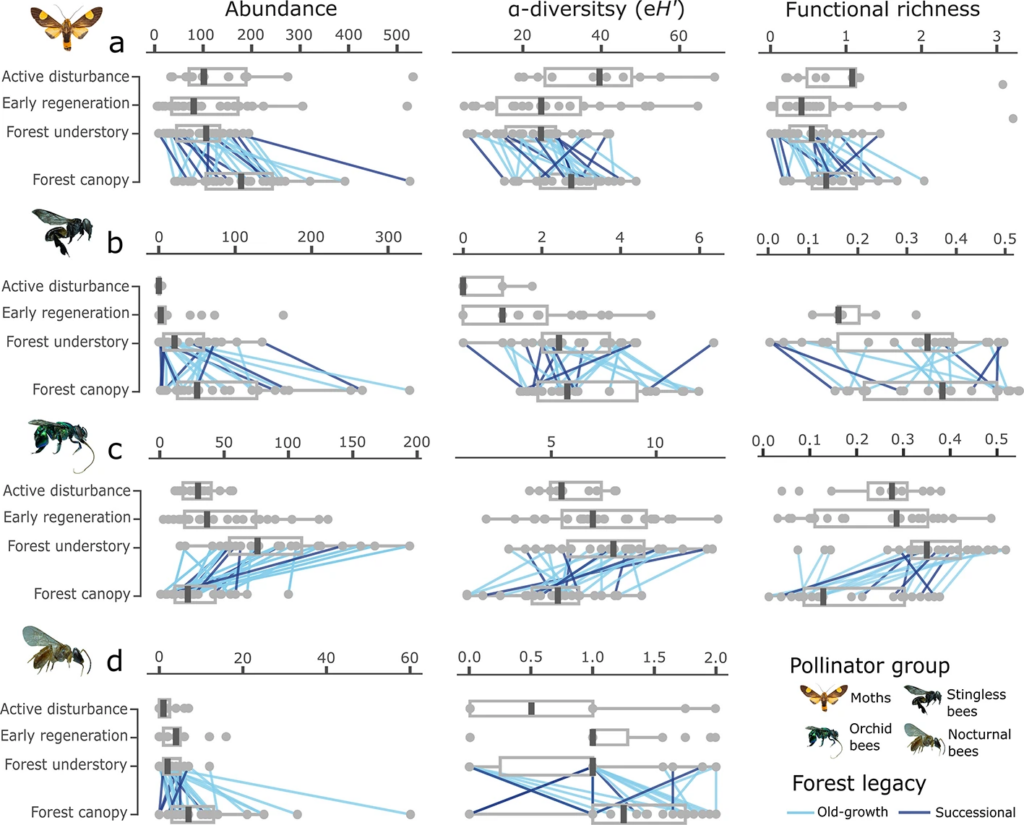
Figure. Abundance (left), alpha diversity (exponential Shannon diversity) (middle), and functional richness (right) of different diurnal and nocturnal pollinator groups along a forest recovery chronosequence and between forest strata (canopy and understory). (a) tiger moths, (b) stingless bees (Meliponini), (c) orchid bees (Euglossini) and (d) nocturnal bees (Megalopta). Forests (plots older than 15 years and with a clear vertical structure) are separated into understory and canopy samples. Lines between points indicate paired samples from the same plot, and line color represents disturbance legacy (old growth in light blue and successional forests between 15 and 38 years of age in dark blue). Functional richness values are not shown for samples with fewer than three species, as was always the case with nocturnal bees