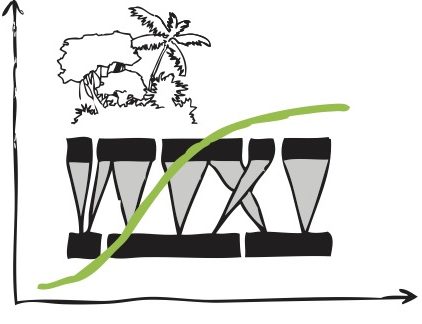

Researchers placed logs from five native tree species across 62 plots along the chronosequence, exposed them in the field for six months. They found that recovering forests hosted more diverse and complex saproxylic beetle-tree interactions. Specialization, however, didn’t follow the expected linear decline: it was actually higher in agricultural and late-regeneration plots.
Wood density also emerged as a filter for some species. Low-density wood held fewer individuals but higher diversity, especially of rare species: softer substrates likely offer more penetrable, heterogeneous niches. Denser, decay-resistant wood still supported high beetle abundance, driven mainly by ambrosia beetles (Scolytinae, 96% of all specimens), which bypass wood hardness by inoculating their own symbiotic fungi.
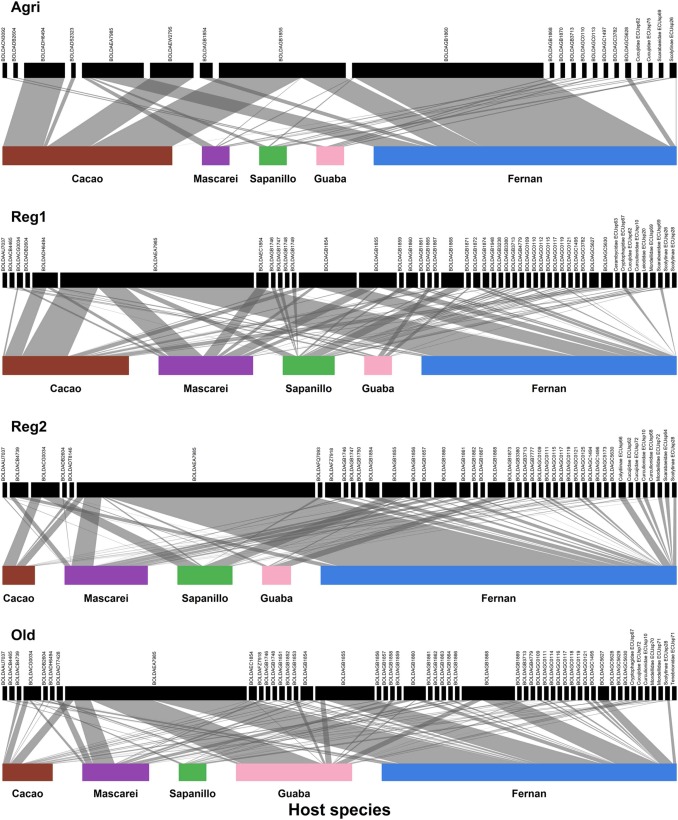
Figure. Network interaction diagrams showing the associations between saproxylic beetle species and the five experimental host tree species across the four forest recovery stages: Agriculture (Agri), Early regeneration (Reg1), Late regeneration (Reg2), and Old-growth (Old). Link width is proportional to the number of saproxylic beetle individuals reared from each host tree species. Host tree species include Theobroma cacao (Cacao), Hieronyma alchorneoides (Mascarei), Trema micrantha (Sapán), Inga spp. (Guaba), and Triplaris cumingiana (Fernán Sánchez)