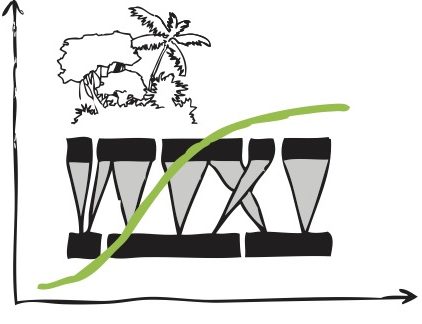

Püls et al. studied tiger moth communities (Arctiinae) along the forest recovery gradient, from active pastures and cacao plantations through regenerating forests to old-growth forest, and recorded 3,612 individuals of 210 species using light traps. They found that differences among communities in species composition and functional traits peaked in recovering forests, while old-growth forests hosted more similar and stable communities, shaped by strong habitat filtering. Traits also shifted along the gradient: agricultural sites were dominated by small, wasp-mimicking species, whereas old-growth forests contained larger, warningly coloured (aposematic) species with higher wing loading. The exception was phylogenetic diversity of rare species, which declined along the gradient, largely due to random rather than selective processes. These results show that functional traits recover relatively quickly in secondary forests, but old-growth forests remain essential for maintaining specialized communities, and easily measured traits such as wasp mimicry could serve as indicators to monitor restoration progress without identifying every species.
Püls M, Kortmann M, Blüthgen N, Schaefer HM, Rabl D, Thompson M, Grella N, Bittermann J, Schreier H-P, Sorger P, Tremlett CJ, Busse A, Seibold S, Kriegel P, De La Hoz MC, Gindhart R, Busch I, Böttger D, Donoso DA, Mitesser O, Müller J, Brehm G (2026) Beta diversity of Arctiinae moths (Lepidoptera: Erebidae) along a recovering tropical forest gradient. Journal of Animal Ecology. https://doi.org/10.1111/1365-2656.70359
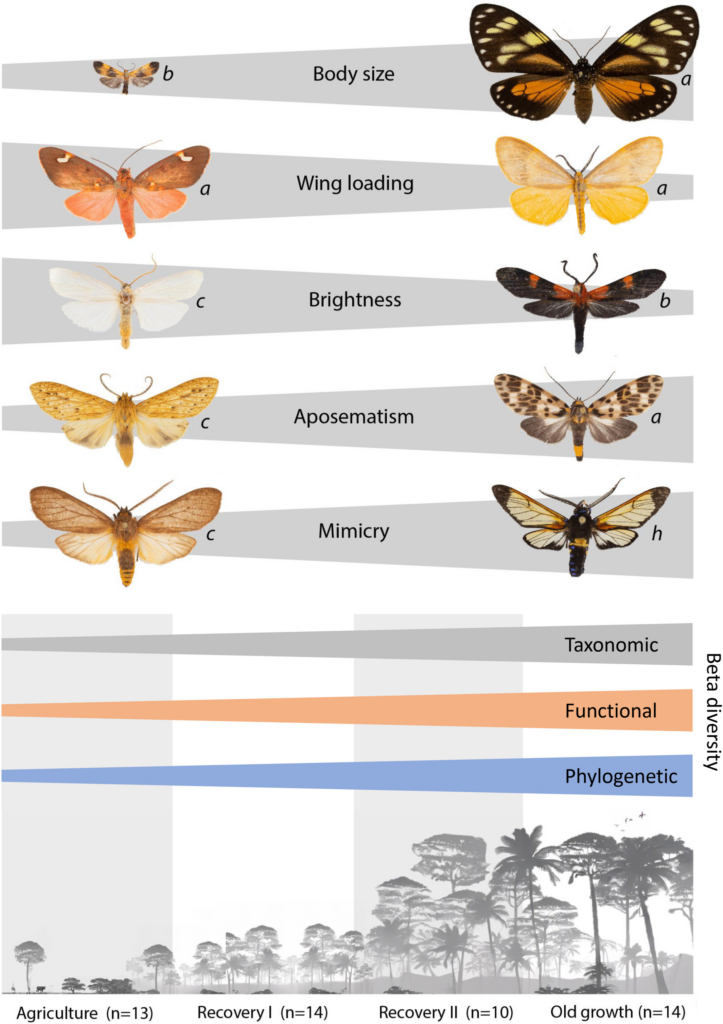
Figure. Predicted shifts of life-history traits of tiger moths (Arctiinae) and hypothesized responses for taxonomic, functional and phylogenetic β-diversity, in four recovery classes (agricultural land, early and late recovery stages and old-growth forest) in the Ecuadorian Chocó. Examples of Arctiinae species and their classification are shown above, representing (a) aposematism, (b) beetle mimicry, (c) cryptic display and (h) hymenopteran mimicry. Shown species (from top left to bottom right): Lycomorphodes nr. correbioides (Schaus), Melese asana (Druce), Agylla zucarina (Dognin), Leucanopsis nr. stipulata (Rothschild), Elysius nr. disciplaga (Walker), Chetone pyste (Druce), Heliactinidia sitia (Schaus), Correbidia sp., Heliura thysbodes (Dognin) and Sarosa lutibasis (Hampson). Taken from the Publication.