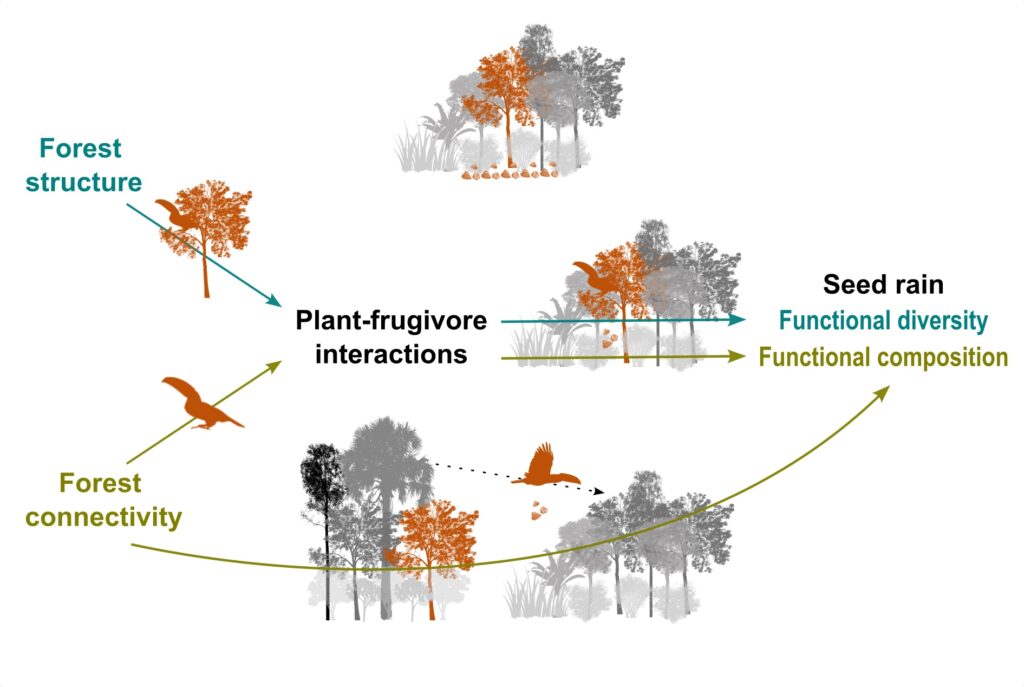

Anna R. Landim and collaborators investigated the functional recovery of seed rain during natural forest regeneration and its underlying drivers. Specifically, they studied how local forest structure and landscape-scale connectivity shape the functional diversity and composition of seed rain driven by animal-mediated seed dispersal. Using plant–frugivore interaction networks combined with functional trait data, they disentangled two complementary recovery pathways: forest structure is the main driver of seed rain functional diversity, whereas landscape connectivity primarily shapes its functional composition. As forests become more structurally complex over time, they support a greater diversity of plant–frugivore interactions, leading to increased functional diversity in the seed rain. In turn, higher connectivity, when regenerating forests are surrounded by other recovering and old-growth forests, facilitates the arrival of late-successional seeds, thereby shaping functional composition. These findings highlight that both local habitat conditions and the broader landscape context are essential for forest recovery, and that integrating both scales is key to restoring ecosystem functioning in tropical forests.