
In our recent paper lead by Nina Grella and colleagues, we tackled a fundamental question in ecology: when a tropical forest recovers from disturbance, what determines which ant and termite species end up where, is it simply that some species can’t reach certain areas, or is it that the habitat itself filters who can survive and thrive? Working across our chronosequence in the Chocó lowland forest in Ecuador, they compared the winged reproductive forms of both insects (alates, which disperse to found new colonies) with established worker communities. The clever insight here is that alates and workers represent different life stages, one focused on dispersal, one on establishment, making them a perfect natural experiment. They found that alates of both ants and termites flew freely across all forest ages, meaning dispersal is not the bottleneck. Instead, it is the habitat conditions that change as forests mature, temperature, humidity, vegetation structure, and available resources, that determine where colonies successfully establish and persist. Both ant and termite diversity also increased with forest age, underscoring just how important old-growth and advanced secondary forests are for maintaining rich social insect communities.
Grella N, Donoso DA, Müller J, Falconí-López A, Busse A, Kriegel P, Püls M, Rabl D, Seibold S, Feldhaar H (2026). Habitat filtering, not dispersal limitation, drives ant and termite community assembly along a tropical forest regeneration gradient. Oecologia 208: 43
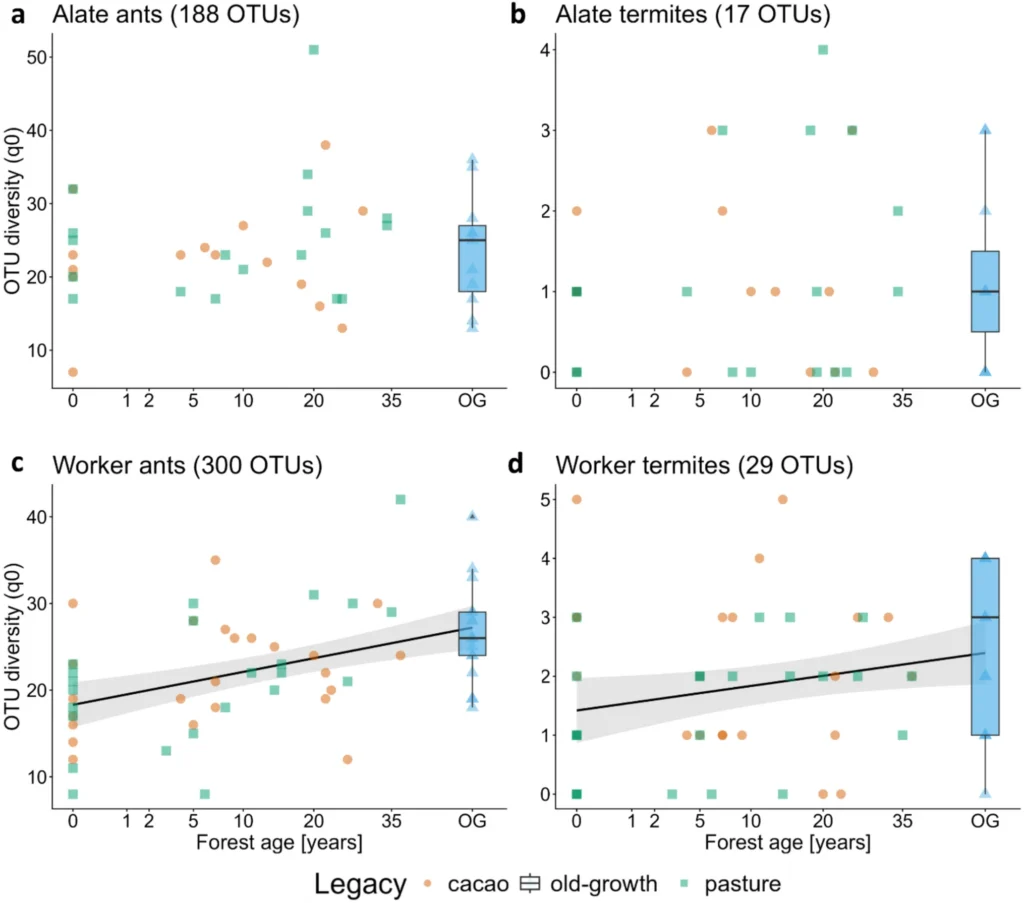
Regeneration trajectories of ant (a, c) and termite (b, d) diversity (number of observed OTUs, q0) along a tropical forest regeneration gradient. Workers (c, d) originate from manual sampling of nest-dwelling or foraging specimen, while alates (a, b) were captured during nuptial flights using light traps. Land-use legacy of active and former pastures and cacao plantations are highlighted by color and shape. Their trajectories are predicted by a linear model with a 95% confidence interval. Solid lines indicate a significant increase in diversity from all plots with forest age according to generalized linear models (Table 1). Old-growth forest (OG) is plotted without forest age for comparison with the regenerating plots