
Our recent article in Nature (see our Post here) may spark an optimistic viewpoint – animal communities in a tropical rainforest recover in a few decades, many of them even completely. Note that we only speak of a complete natural regeneration when, based on the species composition, a secondary forest can no longer be distinguished statistically from an old-growth (or “primary”) forest. Not only the number of individuals or species, it matters which species have recovered: those that are expected to live in a typical undisturbed forest. Based on this definition, it will take over 100 years for all hundreds of tree species typical of the original rainforest to return – consistent with other studies from different tropical countries. The number of individual trees and tree species is slightly faster. However, most animal groups recover much more quickly in our study area. On average, species composition of animals has recovered to 75% after 30 years, that is, three-quarters of the species typical of the original old-growth forest are back within one human generation. Again. the sheer number of species recovers more rapidly than the species composition– over 90% within 30 years. Birds, bats and many insects have already recovered after 10–20 years and are establishing themselves from the surrounding forests. Others take much longer, especially species that cannot fly – e.g. frogs, species living in the leaf litter and soil, or soil bacteria. It’s the soil and litter fauna and microbes which may deserve more attention in the future, perhaps we can facilitate their recovery by transferring soils and litter into young secondary forests.
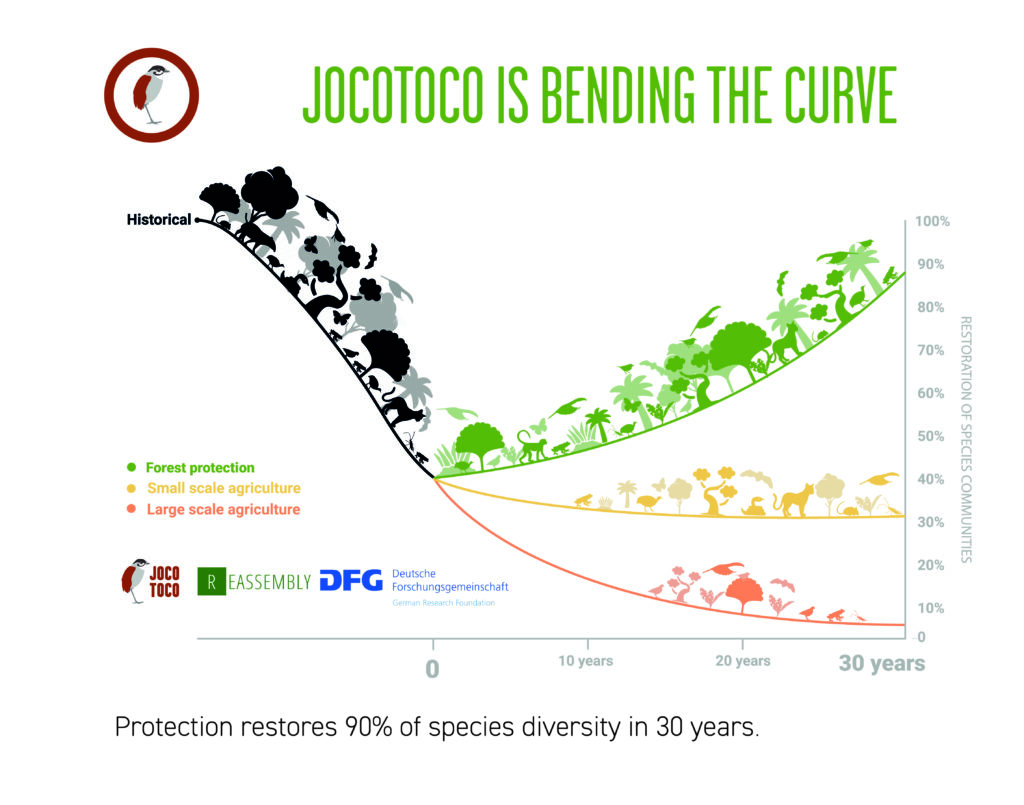
We need to emphasize though that this astonishing speed of natural regeneration, at least for mobile organisms, requires a sufficient area of intact forests in the landscape. The species that colonise the new secondary forests have to come from somewhere. In our study area, the nearest forest is usually less than 100–200 metres away, and three-quarters of the landscape consists of primary and secondary rainforests. In many other landscapes with little forest cover, natural regeneration is unlikely to succeed on its own, at least not at this rate. And many animal species are required to disperse tree seeds, pollinate flowers and perform other important functions. Over 90% of tropical trees depend on insects, bats or birds as pollinators, a similar proportion relies on birds, bats, monkeys and other mammals to disperse their fruits and seeds, and many trees benefit from dung beetles to bury these seeds like gardeners. Natural regeneration of secondary forests therefore requires intact forests in the landscape and a high diversity of animals; otherwise, humans would have to laboriously plant all the trees themselves.
If these conditions are met, natural regeneration (‘passive restoration’) can be a highly efficient way of stopping or reversing regional biodiversity loss, without the need for laborious or costly management. Our results may thus help to spark more urgently needed action to increase the area for ecosystem regeneration. These are important arguments for NGOs such as our partner Fundación Jocotoco for their tireless commitment to nature conservation. Globally, the international community has pledged to protect 30% of the world’s intact natural areas and restore 30% of its degraded ecosystems by 2030 (Convention on Biological Diversity). Unfortunately, we are still a long way from achieving this goal, and need to place far more areas of primary and secondary forest under protection in the tropics and elswhere worldwide. The current situation is even worse: we are still losing 4–6 million hectares of tropical forests worldwide every year (up to 11 ha per minute). These annual losses are almost as high as the total area covered by all very laborious, long-term forest restoration areas combined. So we are losing much more than we gain. Deforestation needs to be stopped immediately, also since rapid natural regeneration is only effective as long as there are sufficient intact forests in the landscape. And also since we know that deforestation may dramatically change the environmental conditions suitable for wet forests including reduced rainfall and increasing droughts. For actual numbers of the current status of deforestation versus forest restoration, see the annual report of the Forest Declaration Assessment initiative. While our study creates hope, and Jocotoco is doing a fantastic job to improve the biodiversity in the Ecuadorian Chocó by including secondary forests – the situation around the world is more than alarming.
Pingback: Rainforest recovery can be very fast for most (but not all) of its components – REASSEMBLY