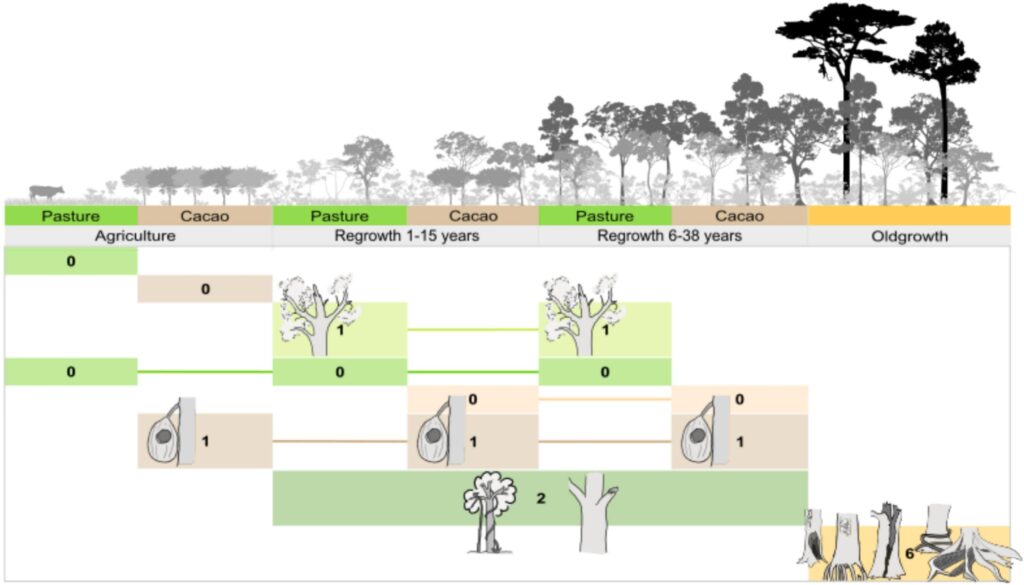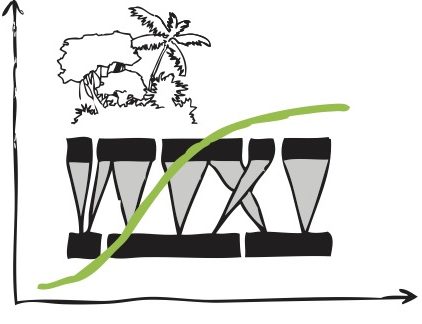

Each tree can offer various structures, attached plants or other microhabitats, summarized as tree-related microhabitats (TreMs). These TreMs represent important niches for animals or other organisms and thus play an important role for the biodiversity in a forest. The importance of multiple TreMs has been studied in temperate forests, but not yet systematically in the tropics. A new catalogue defining a total of 57 different TreMs in tropical rainforests has been complied by Ronja Hausmann (formerly Nußer), Jörg Müller and colleagues (see our Post here). Now Ronja and coauthors applied this idea in their new paper published in Biological Conservation: they quantified the TreMs along the 62 sites in Reassembly, representing a chronosequence of a secondary forests from pastures and cacao plantation in comparison to old-growth forests. They found many TreMs to be relatively unique to undisturbed old-growth forests which rarely or never occurred in secondary forests, particularly buttress roots, two types of trunk rot-holes, insect galleries, broken stiltroot, heavy resinosis anddead lianas. Pastures were poorest in TreMs – although importantly the remnant trees still harbored them. When secondary forests grew on pastures, the diversity of TreMs increased sigificantly with forest age. Cacao trees in plantations provided characteristic TreMs already (particularly dry/old fruits with cavities), and the increase in TreM diversity was weak and not signficant. Both land-use types converged in their TreM composition with age, but did not reach the full compositional profile of old-growth forest after 38 years. This highlights the importance of old-growth forest fragments, remnant trees or old plantation trees remaining in secondary forests to provide a broad profile of microhabitats.
TreM catalogue:
Nußer R, Bianco G, Kraus D, Larrieu L, Feldhaar H, Schleuning M, Müller J (2024) An adapted typology of tree-related microhabitats including tropical forests. Ecological Indicators 167: 112690