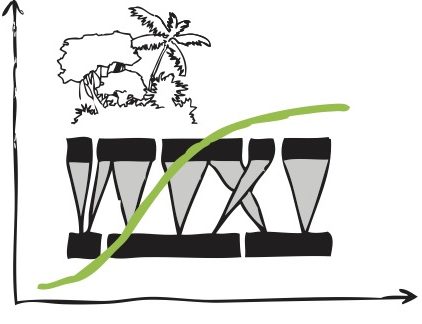

Our first synthesis on phylogenetics was published! In the words of the first author “in this study on the recovery of phylogenetic diversity and phylogenetic community structure, we found that early regenerating habitats do not necessarily harbour closely related species that are later replaced by distantly related ones during late regeneration, as is often expected. Instead, we found that no single assembly rule is followed by all taxa, as different groups respond differently to post-disturbance succession. We also found that phylogenetic diversity can recover relatively rapidly within 50 years for most groups, suggesting that the studied communities are resilient to disturbance from an evolutionary perspective”
Escobar S, Endara MJ, Blüthgen N, Brehm G, Burneo S, Diniz U, Donoso DA, Erazo S, Feldhaar H, Grella N, Keller A, Landim AR, Leonhardt S, Marín-Armijos D, Müller J, Neira-Salamea K, Neuschulz EL, Newell FL, Pedersen KM, Roedel MO, Schleuning M, Tschapka M, Guevara-Andino JE (2025) Recovery of phylogenetic diversity and phylogenetic structure in trees and animals along a chronosequence of tropical forest regeneration Disparate recovery of phylogenetic diversity across taxa during tropical rainforest regeneration. Proceedings of the Royal Society B 292: 20252231 (in press, similar to preprint: https://doi.org/10.32942/X2JK9V)
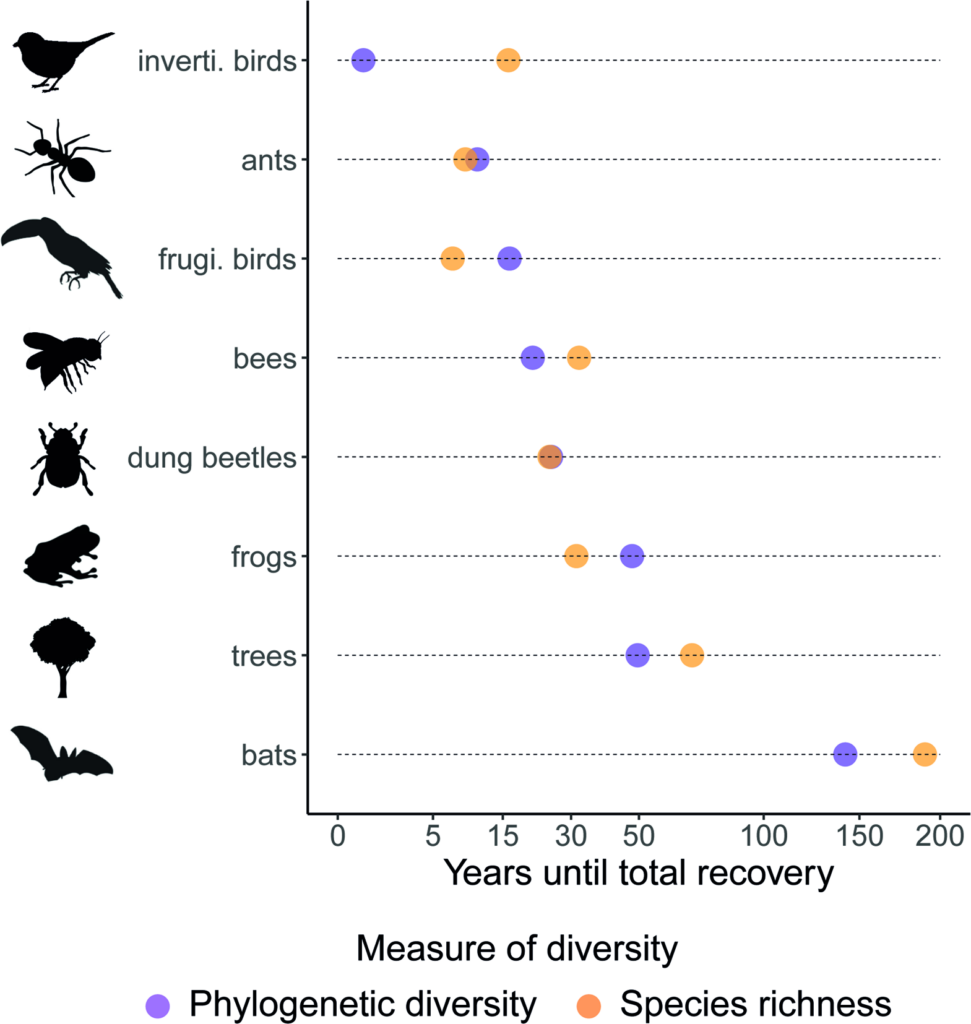
Estimated recovery time of phylogenetic diversity and species richness in trees and animals based on linear models. Taxa are ordered by increasing time until total recovery of phylogenetic diversity.