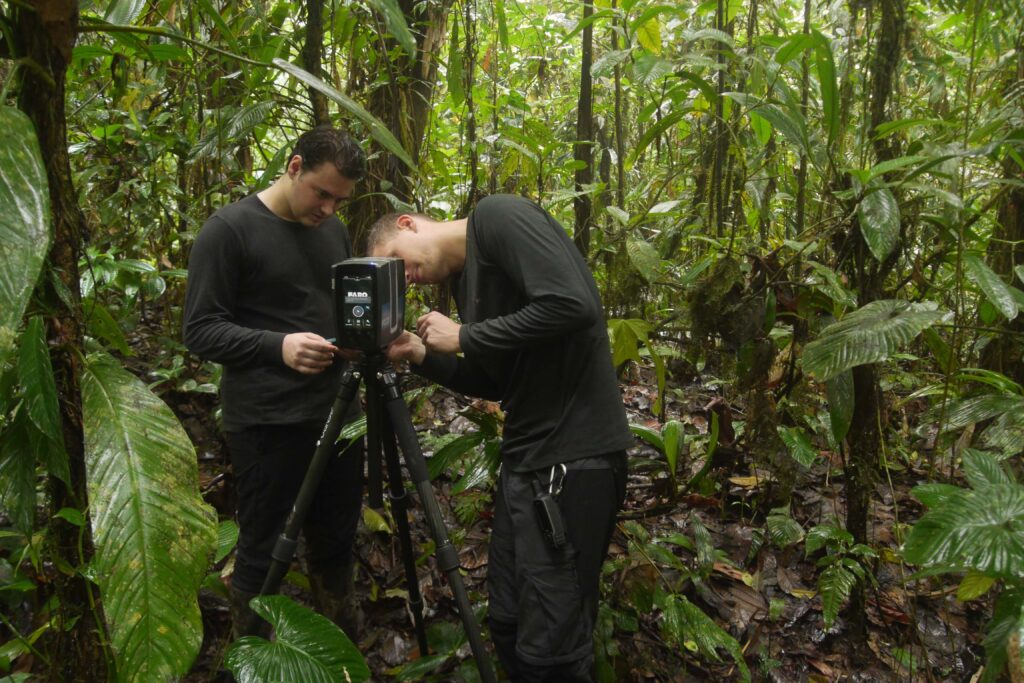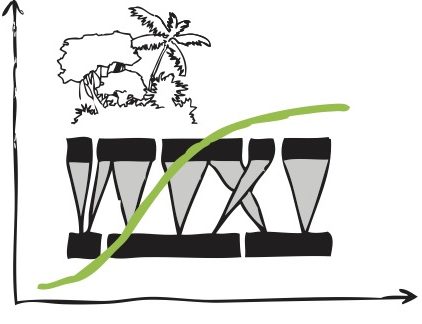

Trees in tropical rainforest generate a structurally very complex habitat, supporting many niches for a huge diversity of species. But how can this structural complexity be quantified? With a terrestrial laser scanner, Martin Ehbrecht and Tim Lehmann studied the three-dimensional vegetation structure along the chronosequence of ‘Reassembly’. In their recent paper published in the Journal of Ecology, they showed that an index of structual complexity increased rapidly with natural forest recovery and reached a level comparable to old-growth forests in less than 40 years. The complexity level was similar to moist tropical forests elsewhere. The structural complexity is closely linked to the diversity of trees and to vertical stratification – and provides another important piece of the puzzle in understanding biodiversity recovery.
Foto: Tim (right) setting up the terrestrial laser scanner in the understory of one of the old-growth plots.