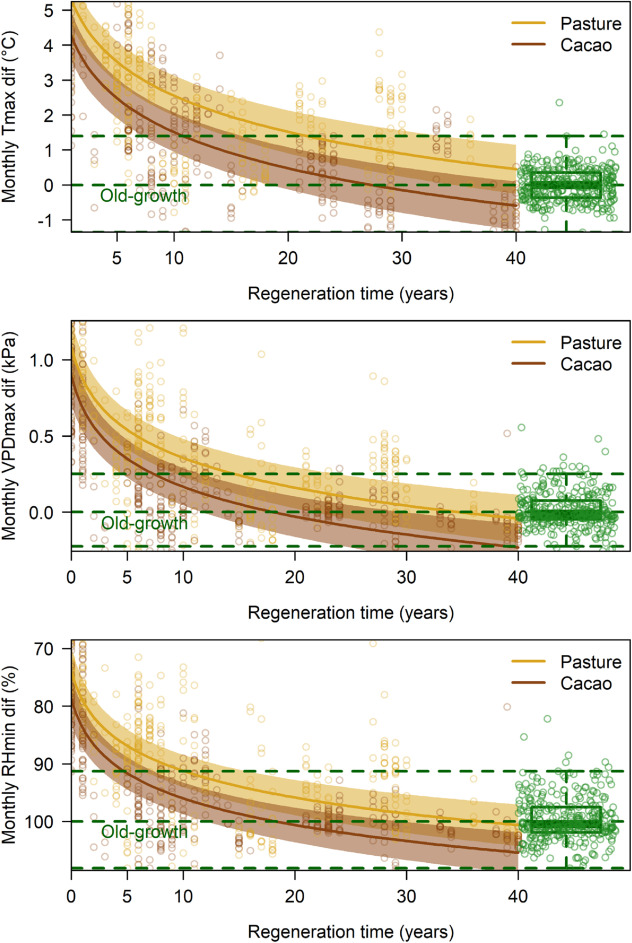

On a hot, sunny afternoon in the tropics, the buffering effect of forests becomes most evident: intact forests are several degrees cooler, and keeps the moisture in the soil and vegetation. Forests maintain much more favourable conditions not only for humans but for any living organism not adapted to heat and drought (if you don’t demand bright daylight, as many plants do). Felicity Newell and co-authors have now quantified the variation in microclimate in 62 plots along the forest succession gradient of ‘Reassembly’.
The new paper, published in Agricultural and Forest Meteorology, showed that, during hot and dry days, intact forests were up to 6.2°C cooler than pastures or young, open secondary forests. The microclimate buffer on Tmax of recovering forests was re-established after 30–40 years for secondary forests growing on previous cacao plantations (where cacao trees provided a small 1.2 °C cooling effect), but it took longer (50–80 years) for forests growing on open pastures. Relative humidity and vapour pressure deficit, which are also highly relevant for organisms, recovered a decade earlier than Tmax. Cloud cover was found to have a strong influence on the cooling effect. Since climate change not only increases hot and dry extremes but also reduces cloud cover in the study area, this becomes a very relevant issue. Our Research Unit will thus investigate such microclimate effects in more detail in future, guided by Felicity Newell, who is a Mercator Fellow for Reassembly. She has just begun a professorship at Texas A&M University.