
Category: <span>News</span>

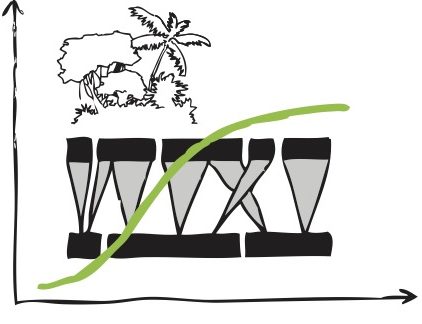
Rainforest recovery can be fast for most (but not all) of its components

How long does it take for a tropical rainforest ecosystem to recover on its own from deforestation? The answer to this apparently simple question required a huge effort achieved by our entire Research Unit and a complex analysis across over 10’000 plant and animal species and over 23’000 bacteria sequences …

Litter decomposition responds differently to small and large-scale disturbance

The paper led by Arianna Tartara explored the process by which fallen leaves are broken down to recycle nutrients back into the forest, recovers after disturbance in Ecuador’s lowland Chocó. Studying sites ranging from active cacao plantations to regenerating secondary forests and old-growth forest, they found that decomposition follows a …

Communities are not only limited by dispersion but also by habitat

In our recent paper lead by Nina Grella and colleagues, we tackled a fundamental question in ecology: when a tropical forest recovers from disturbance, what determines which ant and termite species end up where, is it simply that some species can’t reach certain areas, or is it that the habitat …

Phylogenetic diversity recovers differently across taxa

Our first synthesis on phylogenetics was published! In the words of the first author “in this study on the recovery of phylogenetic diversity and phylogenetic community structure, we found that early regenerating habitats do not necessarily harbour closely related species that are later replaced by distantly related ones during late …

Recovery of structural complexity

Trees in tropical rainforest generate a structurally very complex habitat, supporting many niches for a huge diversity of species. But how can this structural complexity be quantified? With a terrestrial laser scanner, Martin Ehbrecht and Tim Lehmann studied the three-dimensional vegetation structure along the chronosequence of ‘Reassembly’. In their recent …

Uncovering Tiger Moth Richness in the Chocó

Gunnar Brehm and collaborators have published the first systematic inventory of 330 species of tiger and lichen moths (subfamily Arctiinae, family Erebidae) from the Ecuadorian Chocó. They combined field sampling, DNA barcoding, and phylogenetic analyses to assess species diversity, taxonomic knowledge, and evolutionary relationships. Their results show that only approximately …

Unexpected pitviper

In our study site, herpetologists of our Research Unit, led by Mark-Oliver Rödel’s group at the Natural History Museum in Berlin, discovered an individual of a Toad-Headed Pitviper Bothrocophias that was unknown to occur in the lowland Chocó rainforest in Ecuador. Not only its location, but also its taxonomic identity …

Models for proboscis length estimations require taxonomic adjustments in tropical bees

Measuring proboscis length is an essential trait in pollination studies because it influences a bee’s efficiency as a pollinator. However, Frühholz and colleagues showed that existing allometric models developed mainly for temperate species often lack accuracy when applied to tropical bees, leading to under- or overestimation of proboscis length. They …