
Markus Schönleitner and Mark-Oliver Rödel investigated breeding site selection for tadpole deposition in Epipedobates aff. espinosai, a dendrobatid species with terrestrial oviposition, followed by tadpole transport to aquatic sites. Over two months, they recorded tadpole deposition in 79 of 152 artificial breeding sites. Site selection was strongly associated with water level and relative topographic position: frogs consistently prioritized sites containing more water and located at lower positions, regardless of long-term water stability or average water loss. In addition, breeding sites already occupied by tadpoles were more likely to receive further depositions, indicating potential conspecific attraction, possibly reflecting cues of site quality and predator absence. By placing artificial pools in areas where the species had not previously been recorded, the researchers also observed that the frogs rapidly discover and use newly available breeding sites. This indicates both high exploratory efficiency and limited availability of suitable breeding sites. The findings highlight that E. aff. espinosai makes rapid, ecologically informed decisions when selecting breeding sites, guided primarily by immediate water conditions and potentially by the presence of conspecific tadpoles.
Schönleitner M., and M.O. Rödel. (2026). Breeding site choice in the Ecuadorian poison dart frog Epipedobates aff. espinosai (Anura: Dendrobatidae). Salamandra. 62(4): 262-274.
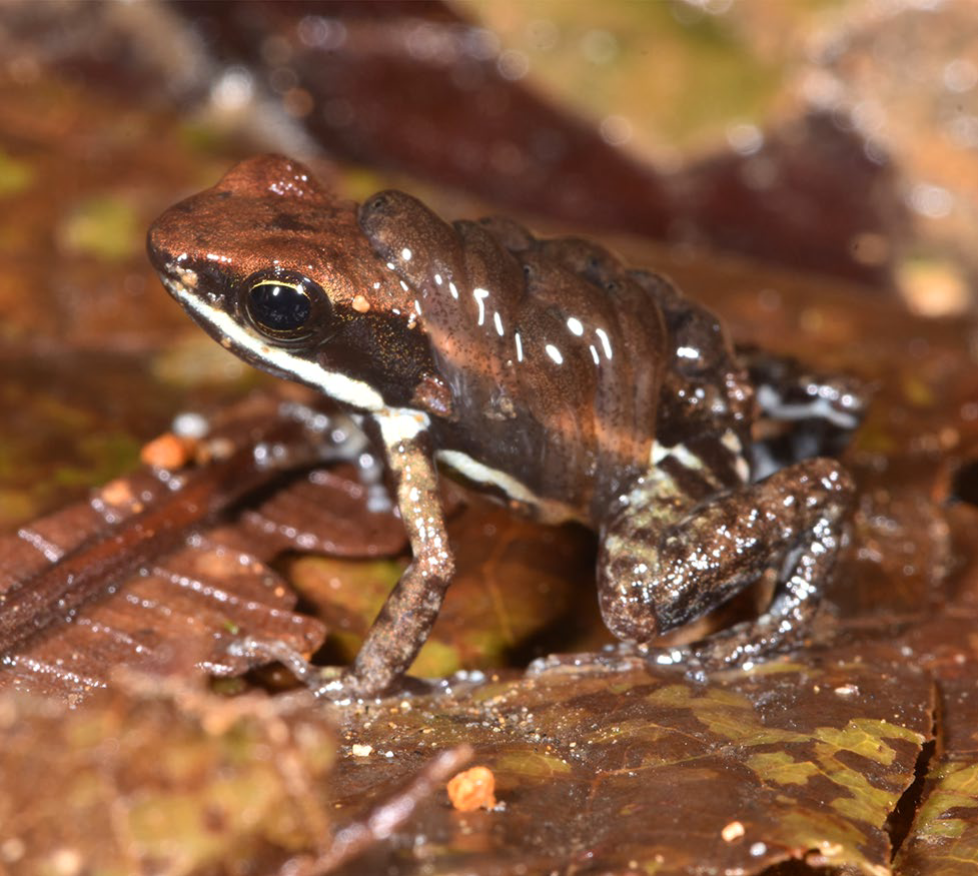
Figure. A male Epipedobates aff. espinosai transporting tadpoles on its back in the Canandé Forest Reserve, Ecuador.