
Written by Mark-Oliver Rödel
While the Reassembly projects mainly focuses on terrestrial plots from pasture to old growth forests, there is also other important habitats in the areas: streams and the riparian vegetation associated with them. The higher humidity along streams and riparian vegetation may allow forest dependent species to disperse through parts of the landscape which otherwise, i.e. due to inappropriate microclimate, are hostile to them. Thus, streams and riparian forest may serve as important corridors for plant and animal species, linking fragmented forests and fostering the reassembly of forest communities. However, these habitats are rarely studied. Therefore, our amphibian and reptile project (SP9, formerly SP2) investigated the composition of stream-obligate amphibians and reptiles along streams, surrounded by habitats at different forest regeneration stages. Their sites covered the entire Reassembly gradient, ranging from actively used cacao plantations and pasture, to regenerating forests, and old-growth forest. In her master project Moira Wiedebusch (now PhD student in phase two) collected environmental data and conducted standardized visual and auditory surveys along 17 stream transects. Through two field periods in 2023 and 2024, she found that forest regenerating stage impacted amphibian and reptile compositions, but in different ways. Species richness was higher in regenerating sites than in active pasture and cacao, and partly even higher than in old growth forest, however, the differences were not always very pronounced. Riparian vegetation and stream microclimate thus seem to buffer effects of habitat degradation in the surroundings. Amphibians showed higher sensitivity to disturbance and Moira found more pronounced species shifts between forest regeneration stages in amphibians than in reptiles. Reptile distributions was more shaped by general environmental conditions including correlated climate and structural variables along the streams. Overall Moira’s study highlights the importance of streams and their riparian vegetation, in both active and regenerating sites for sustaining stream herpetofaunal diversity (and likely other taxa as well) in tropical landscapes such as the Ecuadorian Choco. The study is published open access as:
Wiedebusch, M.L.M., O. Torres-Carvajal & M.-O. Rödel (2026): Riparian amphibian and reptile assemblages in streams along a forest regeneration gradient in the Ecuadorian Chocó. Biotropica, 58: e70250. doi.org/10.1111/btp.70250 .
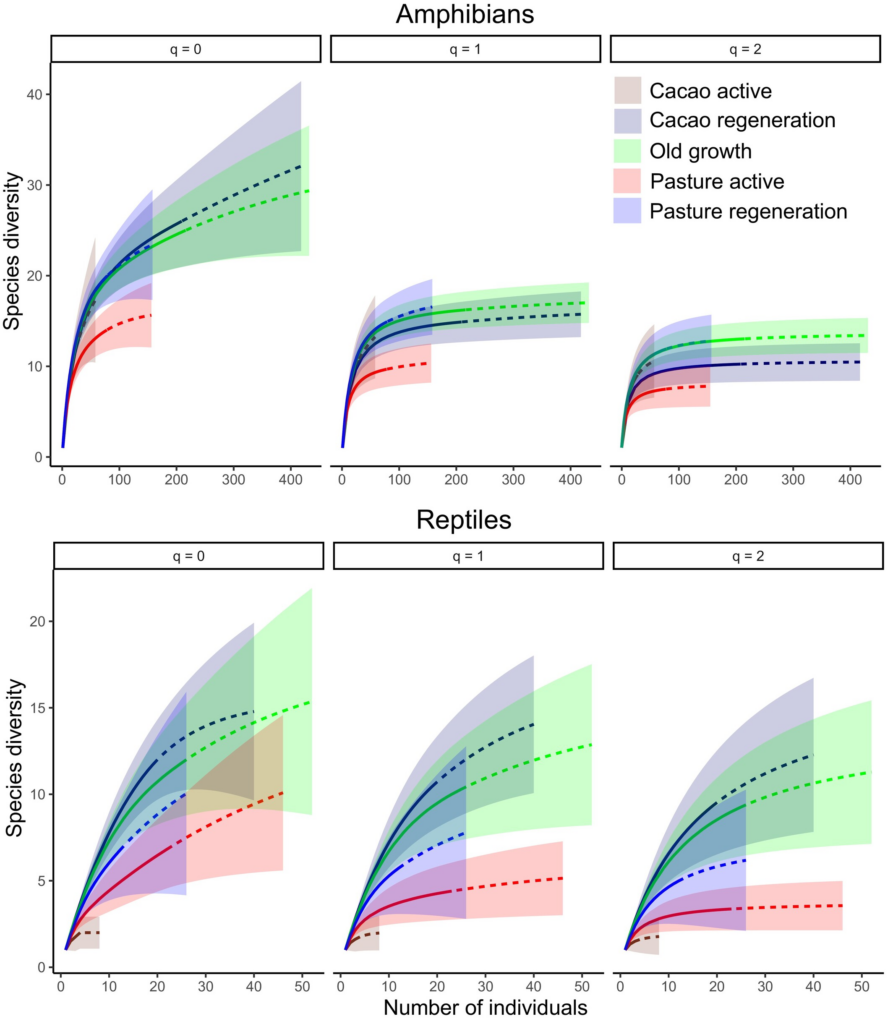
Sample-size–based rarefaction/extrapolation estimates, according to land-use type and regeneration stage, for different diversity measures for riparian amphibians and reptiles: Species richness (q = 0), Shannon diversity (q = 1), and Simpson diversity (q = 2). Continuous line represents rarefaction and dashed line represents extrapolation of sample size.