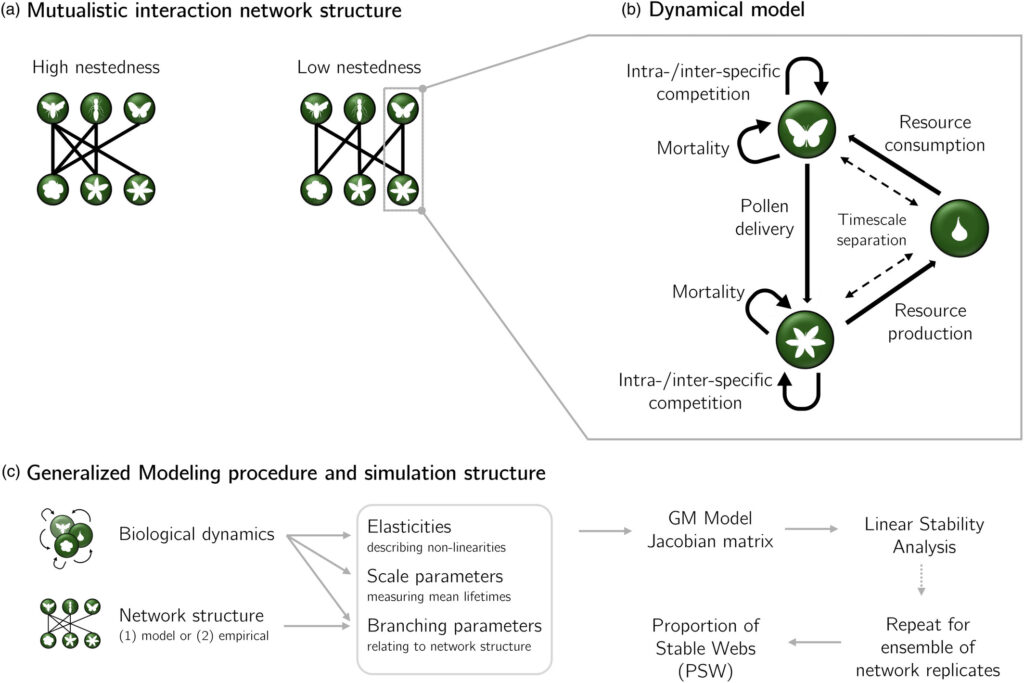

Mutualism is a positive interaction between different species. Pollinators or frugivores and their associated plants are popular examples of many kinds of mutualistic interactions. Mutualisms are relevant and widespread in all ecosystems. The topology of mutualistic networks has long puzzled ecologists and other researchers alike, who have assumed that the stability of such networks in nature is reflected in their topology. Are networks more stable if they are more ‘complex‘ (with more species and links) and more ‘nested‘ (specialists interact with generalists)?? Interpretations and consequences of these patterns have been controversial. A recent paper by Timo Metz and Jan Timo Bachmann provides a very sound answer based on a generalised modelling approach. Their results confirmed the stabilising role of species richness and complexity, but rejected the additional stabilisation of nestedness suggested by numerous other studies (based on unrealistic models that do not include interspecific competition). The number of species – and the number of links – matters!