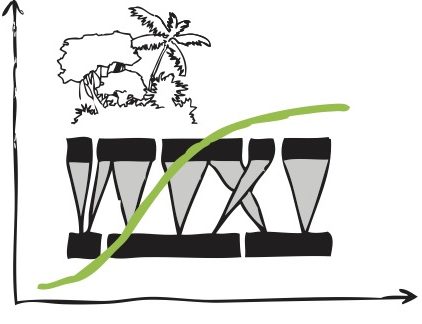

The reptile and amphibian group never ceases to amaze us with new discoveries about the natural history of these animals. Now, moving beyond natural history, they share their findings on ecological recovery. In a publication led by Karla Neira-Salamea, they showed that understory frog communities recover with forest regeneration time. Species richness, diversity, and community composition all increased with regeneration, particularly with the increase in tree basal area, which provides more microhabitats and stable microclimates for frogs. These results suggest that halting deforestation, allowing natural regeneration, and preserving old-growth remnants are critical for the long-term conservation of amphibians in the Chocó. See also the story about this study from Jocotoco.
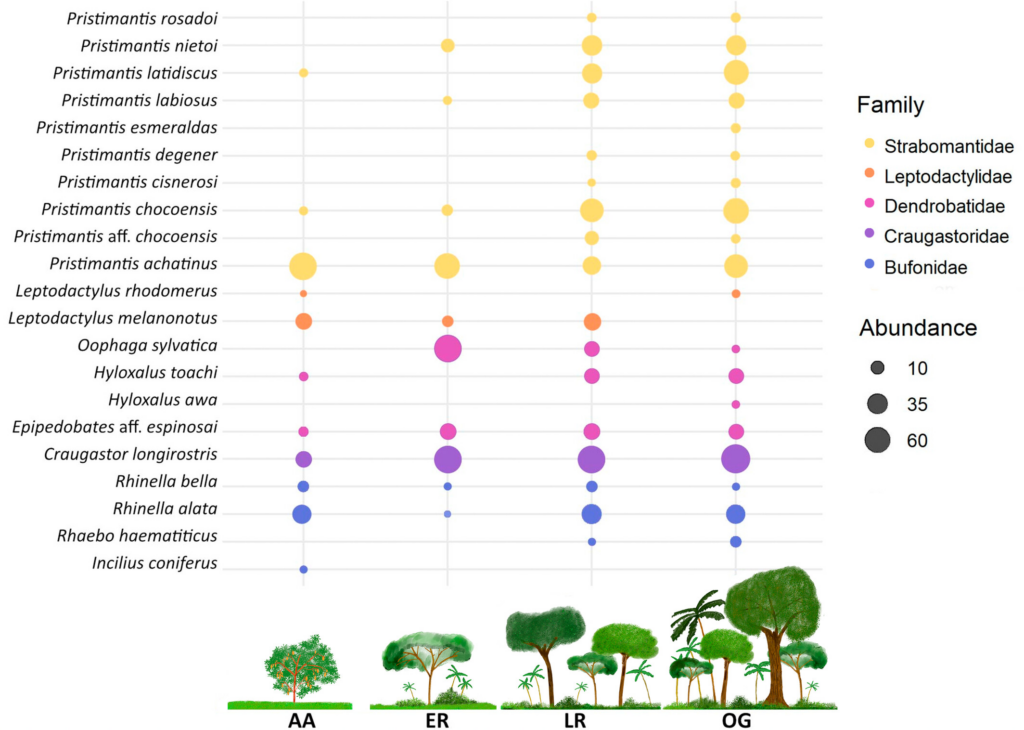
Figure.1 Standardized abundance of understory frog species by habitat successional stages. AA, active agriculture; ER, early regeneration (<15 years old); LR, late regeneration (15–37 years old); OG, old-growth forest. The color of the circles represents the families, while the size of the circles indicates the standardized abundance per number of plots. To standardize abundance, the number of frogs per species in each successional stage was divided by the number of plots sampled in that stage. Illustration created by Karla Neira-Salamea.
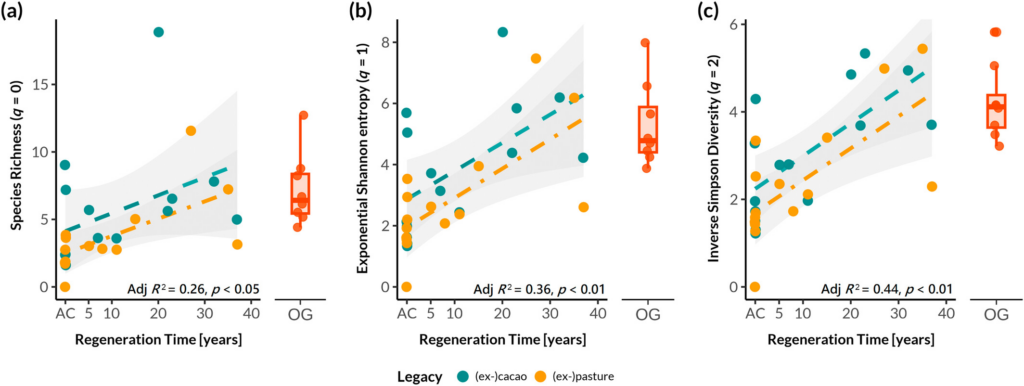
Figure 2. Recovery trajectories showing (a) understory frog species rarefied richness (q = 0), (b) the exponential of Shannon’s entropy index (q = 1), and (c) Inverse Simpson diversity (q = 2) along the chronosequence of forest regeneration. Land-use legacy is highlighted with teal (cacao) and yellow-orange (pasture). Trajectories are predicted from a linear model with 95% CIs. All trajectories were significant. An orange boxplot for old-growth forest (OG) is included as a reference. AC, active agriculture (age = 0).