
Measuring proboscis length is an essential trait in pollination studies because it influences a bee’s efficiency as a pollinator. However, Frühholz and colleagues showed that existing allometric models developed mainly for temperate species often lack accuracy when applied to tropical bees, leading to under- or overestimation of proboscis length. They found that adjusting the models by tribe, genus (or subgenera), and body size greatly improves the accuracy of proboscis length estimations. Based on those finding the proposed a new model for tropical bees.
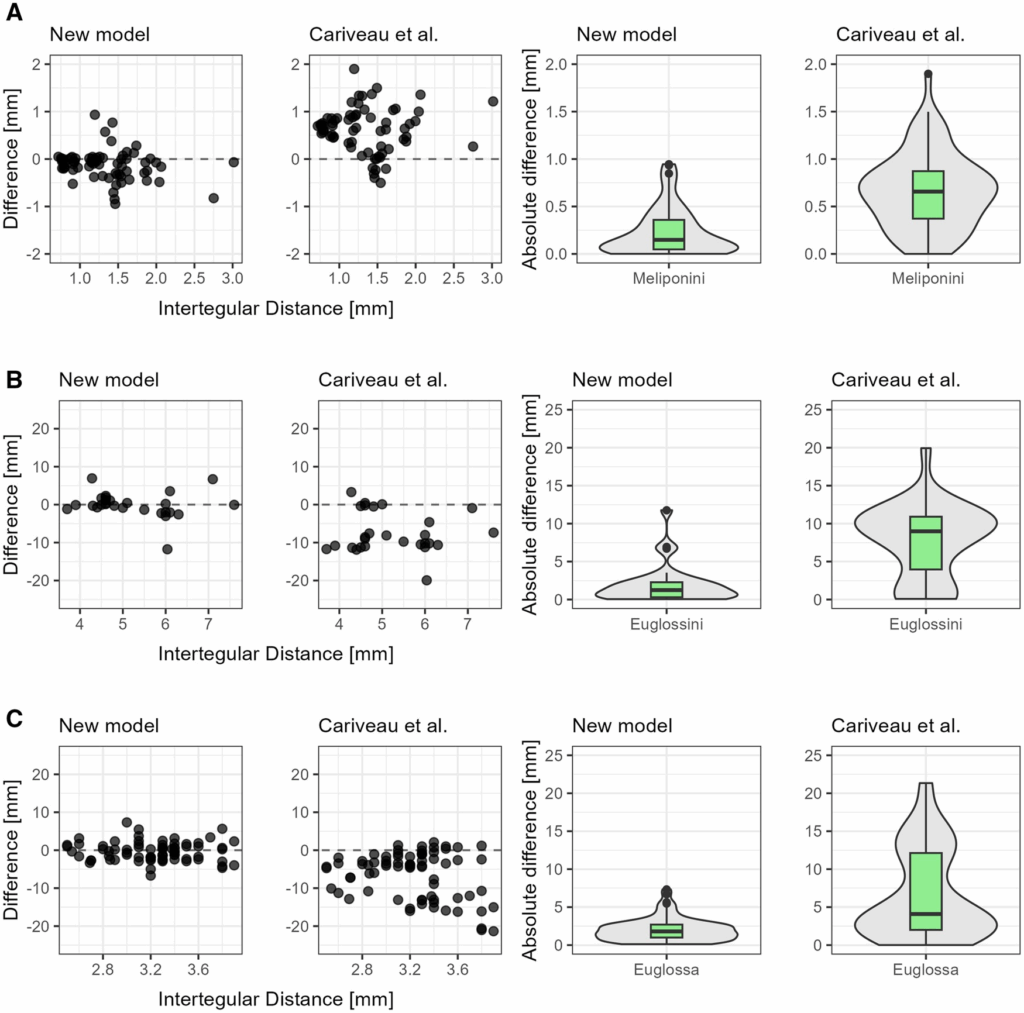
Figure: Error distribution of the model proposed by the authors (New model) and the model of Cariveau et al. (2016) when applied to the evaluation data from Meliponini (A), Euglossini excluding Euglossa (B), and Euglossa (C). On the left, errors are shown as differences between predicted values from the trained model and true values. On the right, the distributions of the absolute differences are shown.