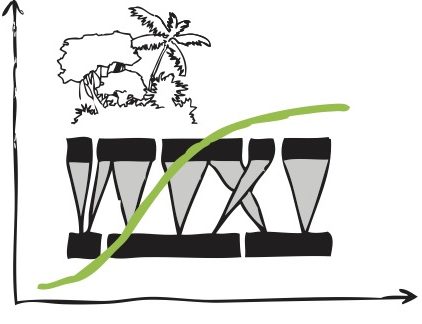

Ugo Diniz and collaborators investigated the recovery of abundance and diversity in Megalopta, a genus of nocturnal bees, and how these bees respond to the availability of floral resources across a forest regeneration chronosequence. They found that even after 38 years of forest recovery, Megalopta communities had not fully returned to levels observed in old-growth forests. Although these bees visited more than 120 plant species and showed flexible foraging behavior across the vertical forest strata in regenerating sites, they remained strongly dependent on pioneer plants. Nevertheless, Megalopta were more abundant and diverse in the canopies of mature forests, suggesting that these habitats provide essential resources such as nesting sites.
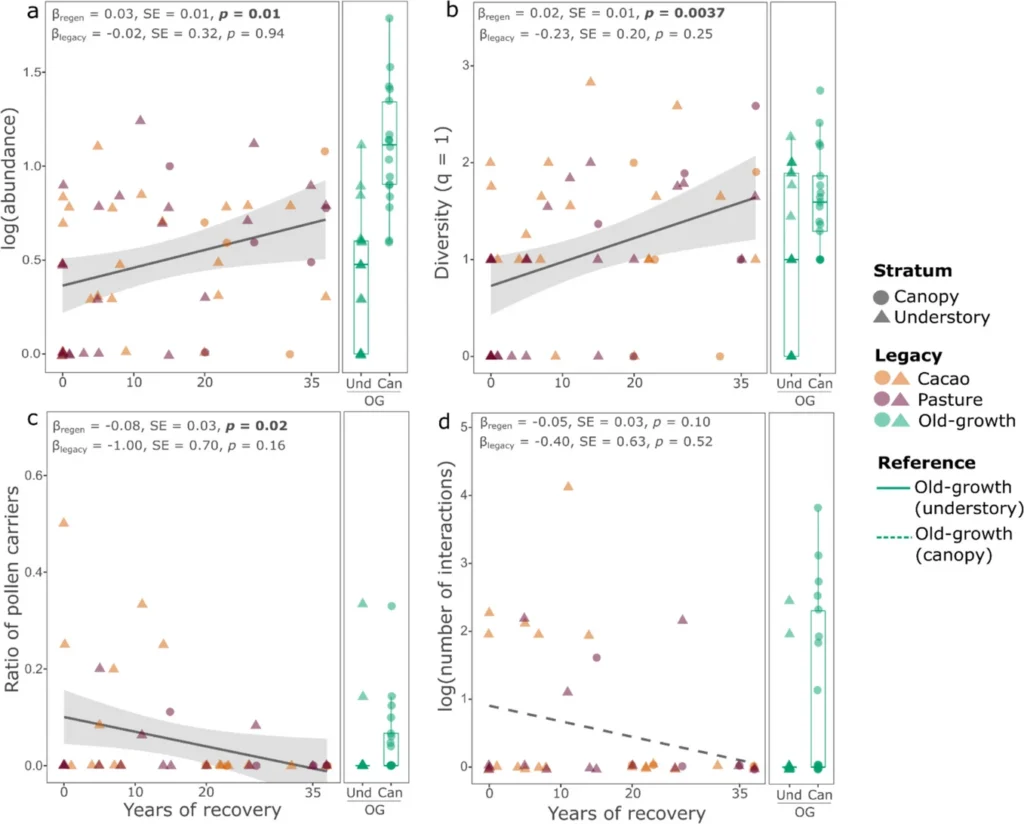
Figure: The recovery trajectories of nocturnal Megalopta bees along a recovery chronosequence in Ecuador in terms of a abundance, b diversity (rarefied exponential Shannon diversity, q = 1), c the ratio of bees carrying pollen, and d the total number of interactions assessed via pollen metabarcoding. Black lines and gray zones represent the fitted models and standard errors. Dashed lines indicate non-significant models. The estimates (β), standard error (SE), and significance (p) of each model are depicted in the upper left corner of each graph. On the right of each graph, old-growth forests (OG) are shown as a reference state before disturbance, with samples separated into canopy (Can) and understory (Und). Samples are colored according to plot legacy, i.e., current or previous use as cacao or pasture, and shaped according to stratum. Taken from Diniz et al. 2025